Dental 3D printing resin.
Built for predictable outcomes
The best dental labs run on materials they trust, suppliers who deliver, and workflows their team can actually manage. Cases go out on time, the dentist calls back with more work, and your team is producing instead of fixing problems.
That’s what professional lab work should feel like.
Trusted by 600+ professionals in nearly 70 countries
Why Choose AmeraLabs for Dental 3D Printing?
Trusted by Dental Professionals Worldwide
EU-Made
Every dental 3D printing resin is formulated, produced, tested, and bottled in our own facility in Kaunas, Lithuania, since 2017. Everything is done in-house by our team, with full control over quality at every step.
Manufactured under ISO 13485
Every batch is manufactured under ISO 13485 quality management and fully traceable. We test raw materials before mixing and finished resin before bottling. Only batches that meet our standards leave the facility.
Professional Support
If you ever need help, our team will respond within 1-2 business days. Ask anything from material selection, print settings to application guidance. Backed by a decade of experience formulating 3D resins, researching material properties, and publishing technical guides.

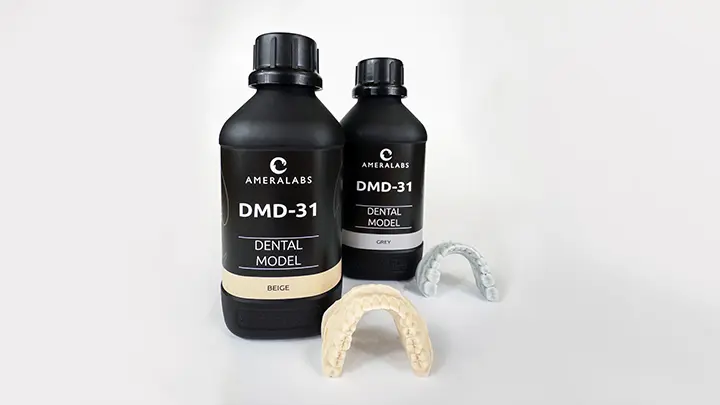
DMD-31: Dental Model Resin
Easy to use dental model resin that lets you focus on your work. A harder surface, tougher construction, and excellent dimensional accuracy deliver reliable results across implant models, removable dies, and wax-ups. Deeper light penetration makes it more forgiving on supports, reducing failed prints and calibration headaches. Available in A2 beige and light grey for clean, professional presentation. Spend less time fiddling with your printer and more time on what really matters.
Shop DMD-31DMD-21: Dental Model Resin
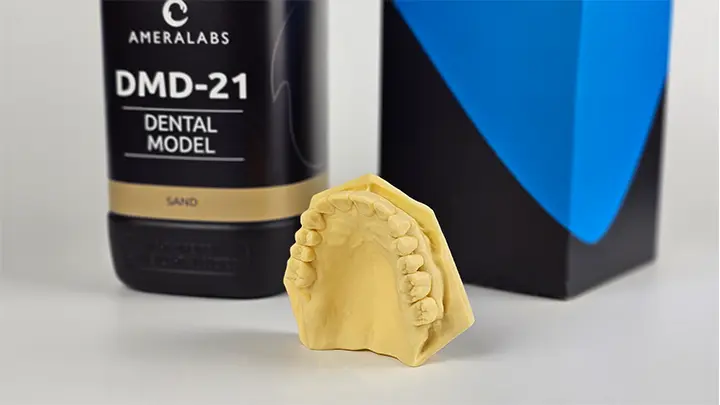
Highly accurate fast curing dental model resin for experienced labs, that have a well established printing workflow. Higher bending stiffness produces rigid, precise models that hold high dimensional accuracy. Faster cure times reduce print cycles on any printer. Its lower viscosity makes vat handling easier and cleaner. Due to its low flexibility, getting the best out of DMD-21 requires solid printing technique. Labs that have it get outstanding curing speed and accuracy in return.
Shop DMD-21GVA-26: Gingiva Mask Resin
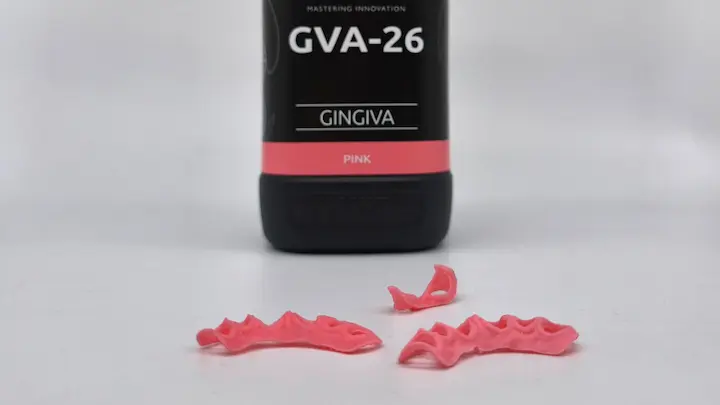
Built for dental models where the material needs to move like gum tissue, not just look like it. Shore A 37 hardness gives it the right compressibility. A 1% compression set means it returns to shape after repeated handling. Tear resistance of 7.8 kN/m holds up through trimming and adjustments. Cut, drill, or trim directly with scalpels or slow-speed handpieces. Available in gum pink.
Shop GVA-26
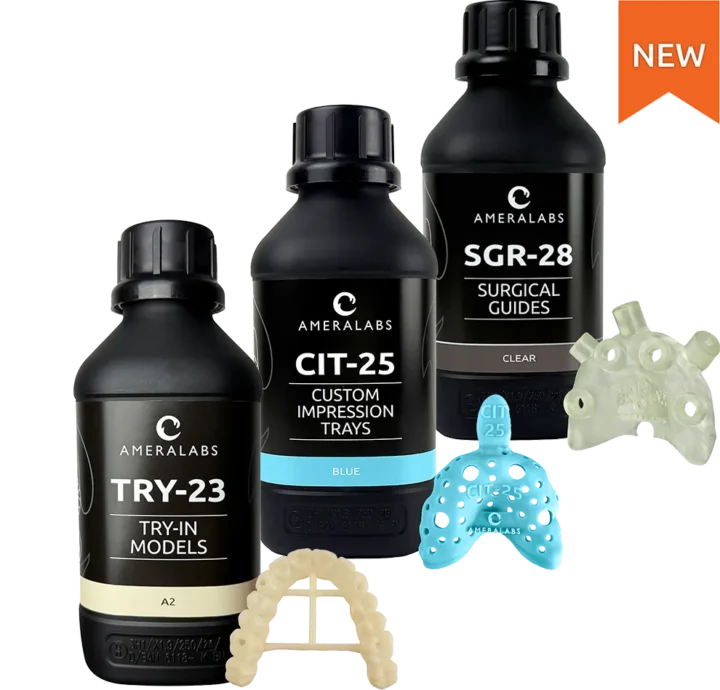
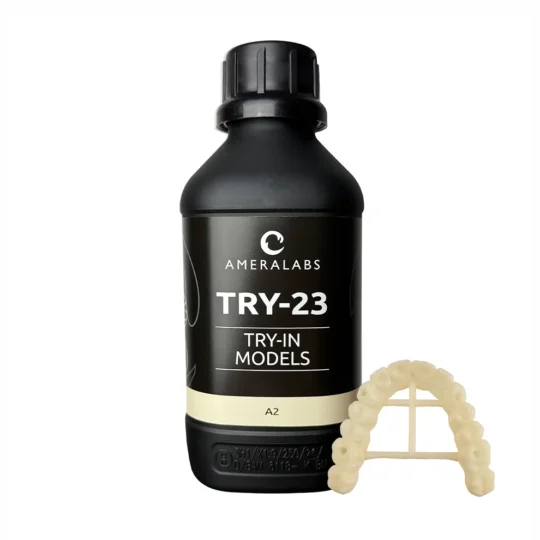
TRY-23: Try-In Resin
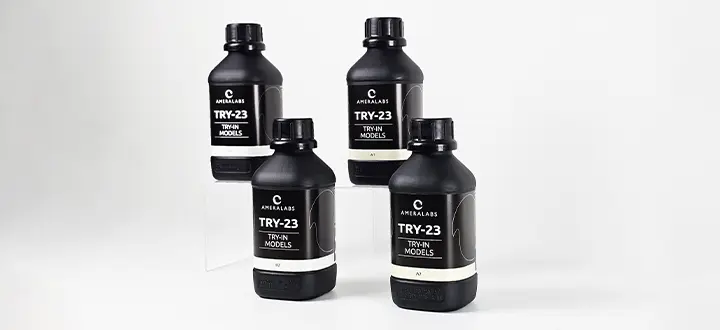
For try-in implant restorations, dentures, and full-arch frameworks. Rigid enough to hold shape accurately from the lab to the chair. Very low water absorption keeps dimensions stable through transit, adjustment, and rescanning. CE Class I marked for intraoral use. Available in shades A1, A2, B1, and B2.
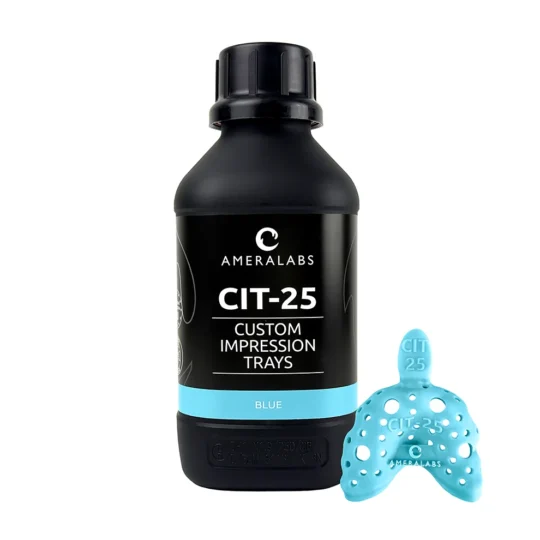
Shop TRY-23CIT-25: Custom Impression Tray Resin
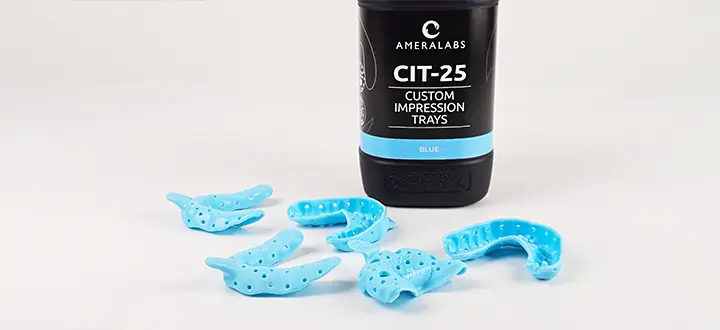
For full-arch and sectional trays, including edentulous, dentulous, and implant cases. Rigid enough to hold arch geometry under chairside pressure without flex or distortion. Compatible with silicone and alginate impression materials without separator sprays. Prints fast and accurate at 200 µm layers. CE Class I marked for intraoral use. Available in blue.
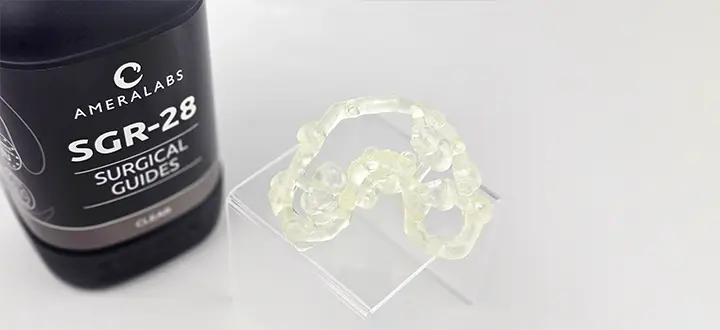
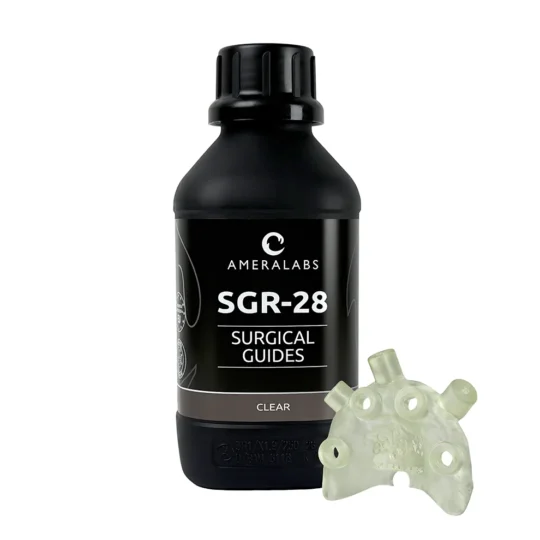
Shop CIT-25SGR-28: Surgical Guide Resin
For dental implant surgical guides, including tooth-supported, mucosa-supported, and full-arch cases. Dimensionally precise with low shrinkage to keep drill paths where they need to be. Flexural strength holds up through handling and surgery without cracking. Accepts both polymer and metal guide sleeves. Autoclavable and CE Class I marked for clinical use. Available in clear.
Shop SGR-28
Book a Private Consultation
AmeraLabs Dental Resin Line
Engineered for precision, speed, and reliability. Our dental resins streamline lab workflows while delivering exceptional accuracy and consistent results - every print, every time.
TRY-23
CE Class I Try-in resin for accurate and detailed dental try-ins

SGR-28
CE Class I Surgical Guide Resin for Accurate Implant Navigation
CIT-25
CE Class I Custom Impression Tray Resin for Fast and Accurate Trays
Frequently asked questions
Why do some models still have fit problems even with low-shrinkage resin?
Fit issues usually come from print orientation, support placement on critical surfaces, room temperature changes, or long IPA exposure. Validated settings for your printer and stable lab conditions reduce most of them.
Printing at 22 to 25 °C and avoiding excessive IPA soaking makes a noticeable difference. Support removal from seating surfaces is especially important. Small workflow adjustments solve issues that low shrinkage numbers alone do not fix.
How long should I wait before thermoforming aligners?
Thermoform within 24 to 48 hours after post-cure for the most accurate results. Models can change shape slowly over time as they respond to temperature and humidity.
For critical aligner or retainer work, printing and forming the same day or next day gives the most predictable fit and reduces remakes.
What causes yellowing on dental models?
Over-curing is the most common cause of yellowing. Stop post-curing as soon as the surface is fully non-tacky. DMD-21 resists yellowing better when you stay within recommended cycles.
Store finished models away from direct sunlight. Indoor lab conditions usually preserve color well for normal use. Over-curing also makes models more brittle, so staying within recommended times helps both color and strength.
How do I get clean trims on gingiva masks?
Use sharp scalpels for borders and slow-speed handpieces under 10,000 RPM. Cooling the part to about 5 °C for 10 minutes helps with fine emergence profiles.
GVA-26 has 7.8 kN/m tear resistance, but technique still matters. A brief cool-down makes intricate trimming cleaner and reduces the chance of tearing around thin areas.
Should I use DMD-21 or DMD-31?
Pick DMD-21 for speed and DMD-31 for ease of use.
Are these resins safe for patient contact?
Some. CIT-25, SGR-28, and TRY-23 are CE marked Class I medical devices for use by dental professionals and are safe for short-term patient contact.
DMD-21, DMD-31, and GVA-26 are for laboratory use only and are not intended for patient contact.
How do I minimize distortion on long-span models?
Use proper support placement, print at stable room temperature (22 to 25 °C), and avoid excessive IPA soaking. Adequate wall thickness when hollowing also helps.
Long-span models are more sensitive to orientation and post-processing than short-span work. Validated settings and consistent lab conditions give the most predictable results for larger cases.
What is the best way to store printed dental models?
Keep them in a cool, dry place away from direct sunlight, and use them within one week for critical work. DMD-31 has particularly low water absorption (0.19%, ASTM D570) and handles longer storage better.
Sealed containers with desiccant work well for important cases or study models. Storage conditions matter more for long-span and implant work than for simple study models.
Better Prints, Made Simple!
- Downloads, Tutorials
Business Resin Printing Setup Guide & Checklist
Start your business resin printing setup right! Learn tips for choosing printers, ensuring safety, and…

- Tutorials
Resin 3D Printing Troubleshooting: A Comprehensive Guide
Resin printing is a complex process with various factors at play, often leading to simultaneous…