Engineering resins for 3D Printing.
Stop redesigning around your resin's limitations.
Whether you’re printing drone components, soldering jigs, or parts that need to stay flexible under real load, the material has to match the job. Not the other way around.
Trusted by 600+ professionals in nearly 70 countries
Problems Solved, Production Running
Your Reliable Resin Partner
EU-Made
Every resin is formulated, produced, tested, and bottled in our own ISO certified facility in Kaunas, Lithuania, since 2017. Everything is done in-house by our team, with full control over quality at every step.
Consistent
We test raw materials before mixing, then test finished resin before bottling. Composition and curing speed verified at both stages, plus any properties specific to that resin. Only batches that meet our standards leave the facility.
Professional Support
If you ever need help, our Lithuanian based English speaking specialist will respond to you within 1-2 business days. Ask anything from material selection, print settings to application guidance. Backed by a decade of experience formulating resins, researching material properties, and publishing technical guides.
Customers Feedback
"AmeraLabs resins have become our go-to material for functional 3D-printed parts. They deliver the consistency, accuracy, and durability we need for both product components and service tools. We're very satisfied with the results and can confidently rely on them for our daily production."
"We tested the XVN-50 and AMD-3D. Great resins that work well with our Formlabs 4L. We are very happy with the product and the exceptional customer support."
"Is this resin versatile? Yes, the resin is versatile and in these tests it does live up to its claims. It is a very capable resin and well, you get what you pay for."
Need Assistance With a Project?
Whether you need more details, guidance, or clarification, we’re here to help.

XVN-50: Versatile Engineering Resin
For functional parts that take real load - snap fits, brackets, jigs, drone components, press tools. Parts that need to survive actual use, not just look good on a desk.XVN-50 balances impact resistance, flexibility and tensile strength in one material. It absorbs force without snapping and holds its dimensions under load. You get parts that fit, function and last.
Shop XVN-50
FLX-300: Flexible Elastomer Resin
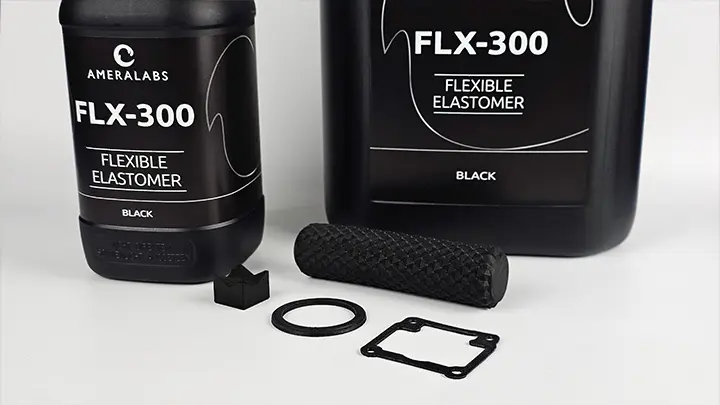
For parts that need to flex, compress and return to shape - gaskets, dampers, grippers, custom-fit components. Anything that takes repeated mechanical stress without being allowed to permanently deform.FLX-300 stretches and compresses like rubber, with 232% elongation at break and Shore A 44 hardness. Its 1.7% compression set means it springs back to its original shape after load is removed. Low water absorption keeps it stable in humid conditions.
Shop FLX-300ESD-R-100: ESD-Safe Resin
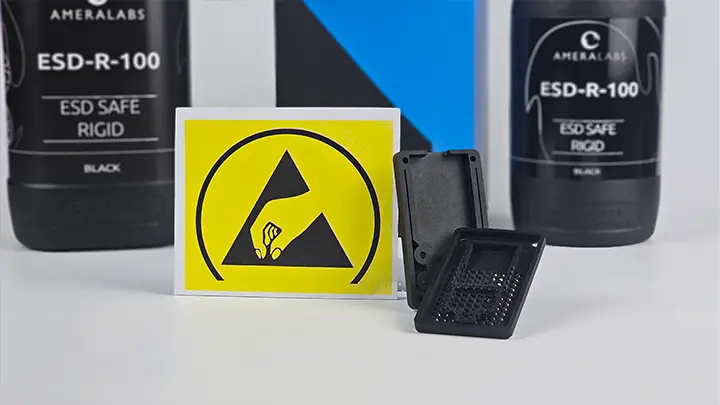
If you work in electronics manufacturing, you know that electrostatic discharge can kill components. Any jig, tray, fixture or tool that touches sensitive parts needs to be ESD-safe.Standard resins put your components at risk. ESD-R-100 has a surface resistivity in the range of 10⁷ to 10¹⁰ ohm/sq, safely dissipating electrostatic charge. It is hard and dimensionally stable, with a 160°C glass transition temperature that makes it suitable for soldering environments.
Shop ESD-R-100AMD-3: Silicone Mold Master Resin
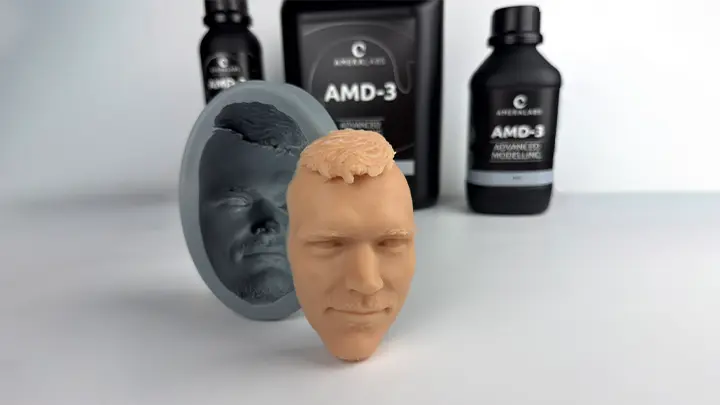
Some parts need to be polyurethane, epoxy, or wax - materials you can't 3D print directly. The answer is to 3D print a precise master, pour a silicone mold around it, and cast the part you actually need. AMD-3 was formulated specifically for this workflow - it doesn't inhibit platinum silicone cure, so the mold cures cleanly. Low shrinkage and high dimensional accuracy mean that every detail of the design is captured accurately, giving you a precise, clean mold to cast from.
Shop AMD-3
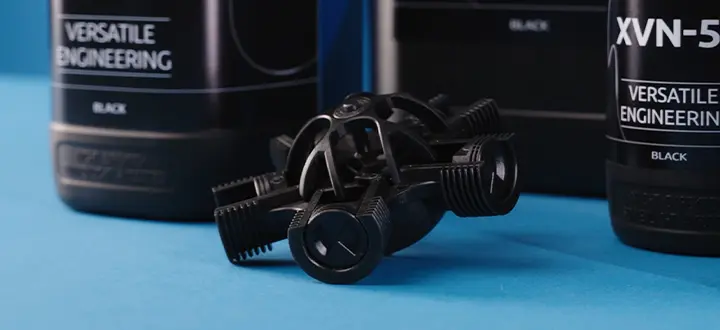
Our Bestseller XVN-50 in Action!
Frequently asked questions
Why do my functional prototypes keep cracking under load?
Most standard resins look strong but crack when actually tested. XVN-50 has higher strain at break (51.2%, ISO 527-5A) and 5.9 kJ/m² notched impact resistance, so parts survive real mechanical stress.
This reduces reprint cycles and makes your test data more reliable when moving toward production. Engineers running early field trials use it to avoid unexpected failures in the test rig.
What engineering resin should I choose for flexible gaskets or dampers?
FLX-300 is the right choice for gaskets, seals, vibration dampers, and soft grips that need to compress and return to shape repeatedly. It is 44 Shore A with 1.7% compression set at 25 °C after 72 hours.
It holds softness over time, while a lot of generic flexible resins keep curing in storage and harden within weeks. That makes FLX-300 reliable for parts that need consistent performance after many cycles.
Can these resins be used for outdoor parts?
XVN-50 and FLX-300 work for sheltered outdoor use. For direct sunlight or constant weather exposure, apply a UV-protective coating or pick AMD-3 instead.
Always test in your actual conditions. Photopolymer resins generally have limits with prolonged UV and moisture, so a coating or different material can extend service life significantly.
How do I create reliable screw threads in XVN-50?
XVN-50 holds tapped threads for normal use. For parts that will be disassembled often, brass heat-set inserts last longer.
The material is tough enough for normal workshop handling without cracking around the thread. Heat-set inserts remain the right choice for high-cycle applications where thread wear becomes an issue.
Is ESD-R-100 suitable for machining?
Yes. The static-dissipative property is throughout the material, so drilled, sanded, or machined surfaces stay effective.
This is the main advantage over surface-coated ESD plastics, where machining removes the conductive layer. ESD-R-100 jigs and fixtures can be modified after printing without losing protection.
Why does my flexible part harden over time?
Generic flexible resins keep curing slowly after post-cure, which is why they stiffen over weeks or months. FLX-300 was reformulated specifically to avoid that problem and holds its softness under normal conditions.
Engineers tend to choose it after getting tired of replacing parts that stiffened on the shelf or in service.
What is the best resin for high-detail mold masters?
AMD-3 is our recommendation for mold masters. It is sulfur-free, so RTV platinum-cure silicone sets without inhibition. It also holds fine detail with good dimensional stability.
Standard photopolymers often contain sulfur compounds that inhibit platinum-cure silicone, leaving the silicone tacky against the master. AMD-3 contains none, so the silicone cures fully on the first pour.
How should I clean ESD-R-100 jigs?
Use IPA and wash thoroughly. ESD-R-100 has higher viscosity than clear resins, and the carbon pigmentation can leave residue, so change the wash IPA more frequently.
Dry parts completely with compressed air before post-curing. Trapped solvent can affect surface resistivity and mechanical properties over time.
Better Prints, Made Simple!
- Tutorials
23 Resin Safety Myths a Resin Manufacturer Wants You to Know
Introduction We formulate and manufacture 3D printing resin at AmeraLabs. We know what goes into…

- Tutorials
Resin 3D Printing Troubleshooting: A Comprehensive Guide
Resin printing is a complex process with various factors at play, often leading to simultaneous…

- Tutorials
How to design parts for SLA 3D Printing
In this article we will cover key design elements of SLA 3D printed parts. It…