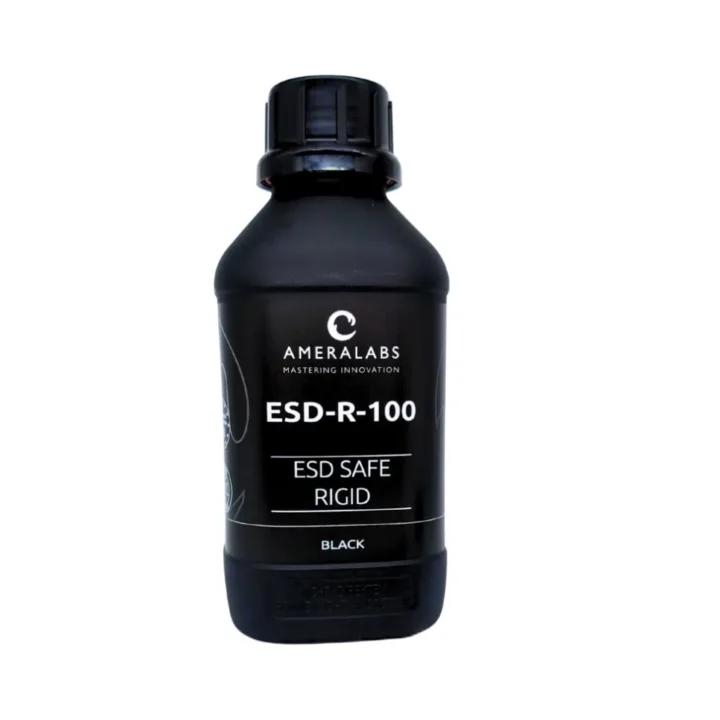
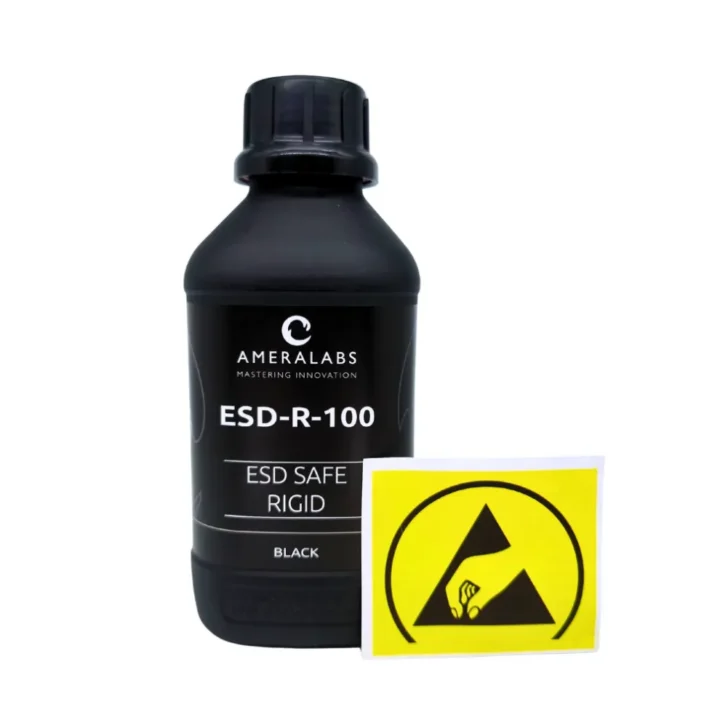
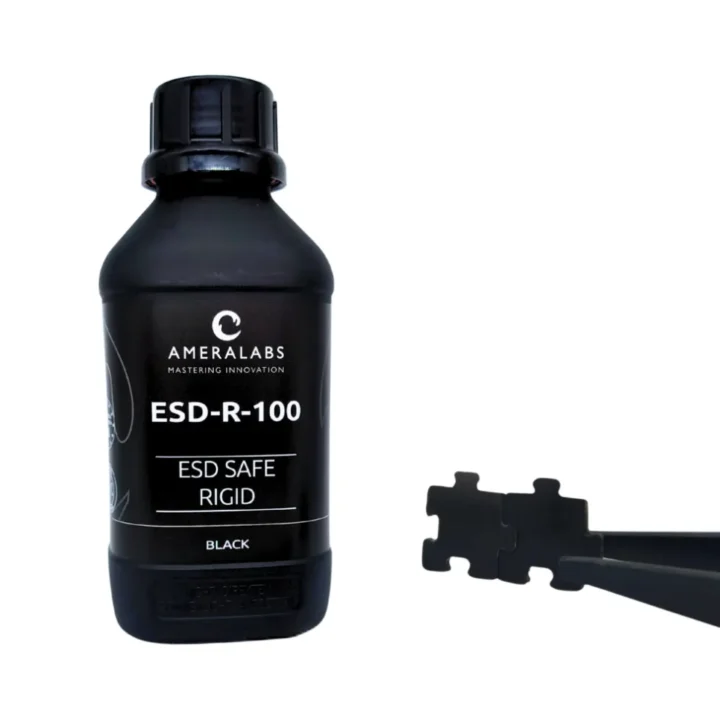
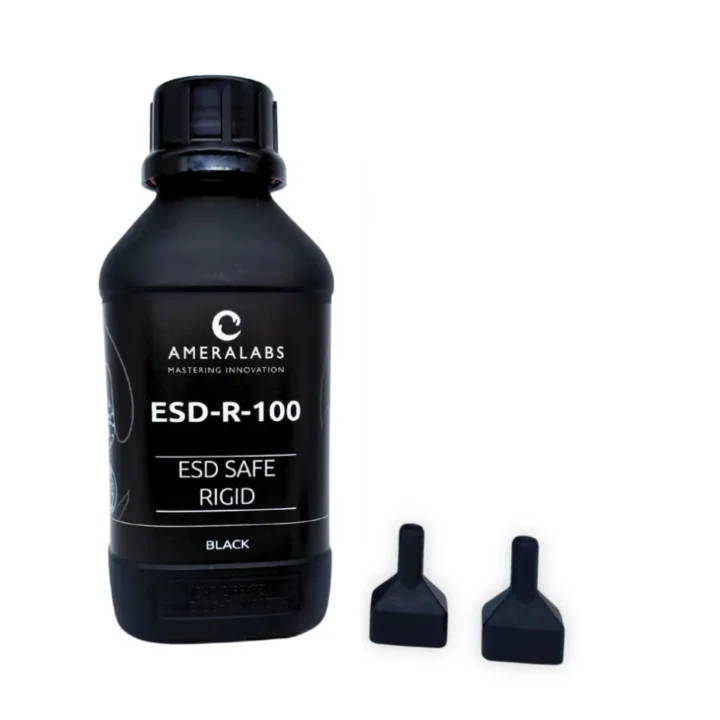
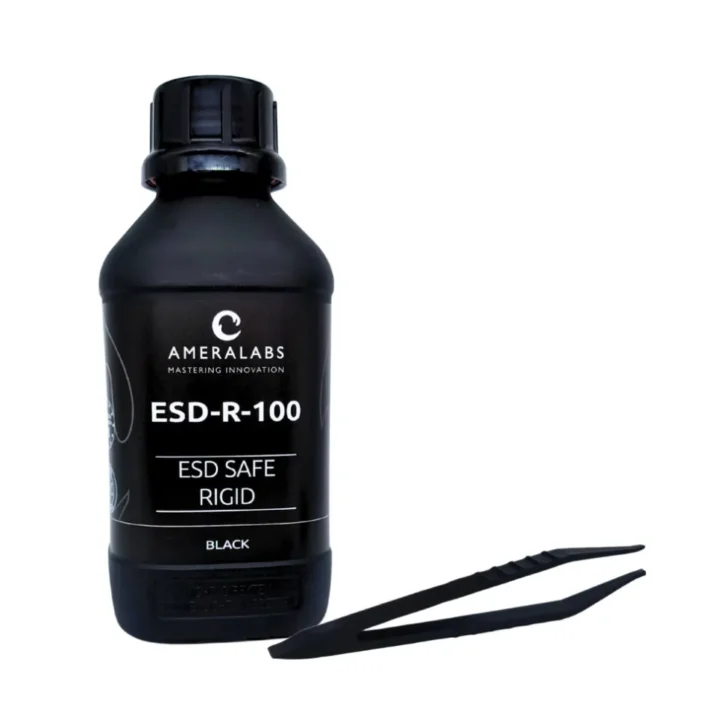
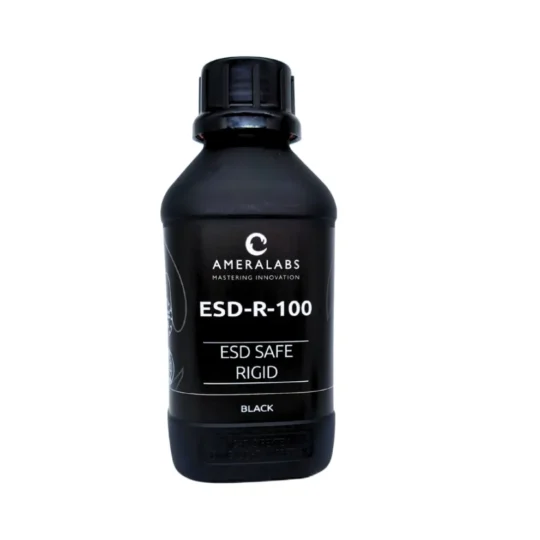
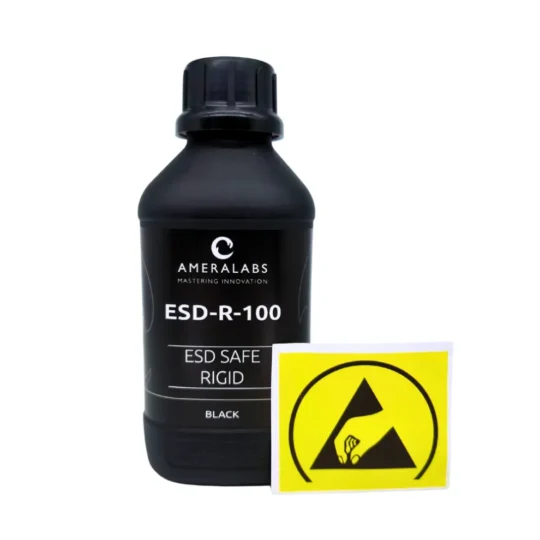
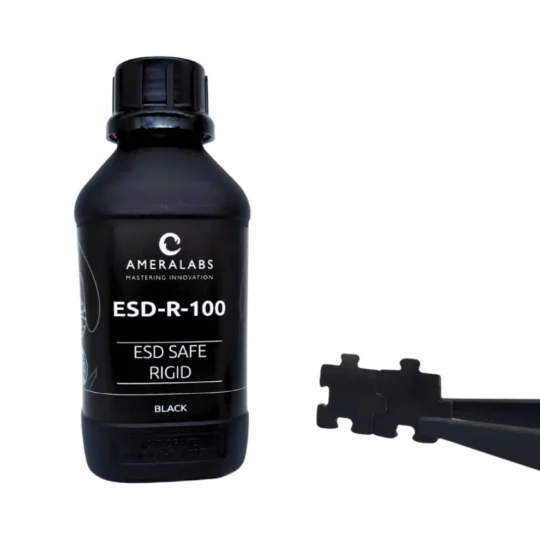
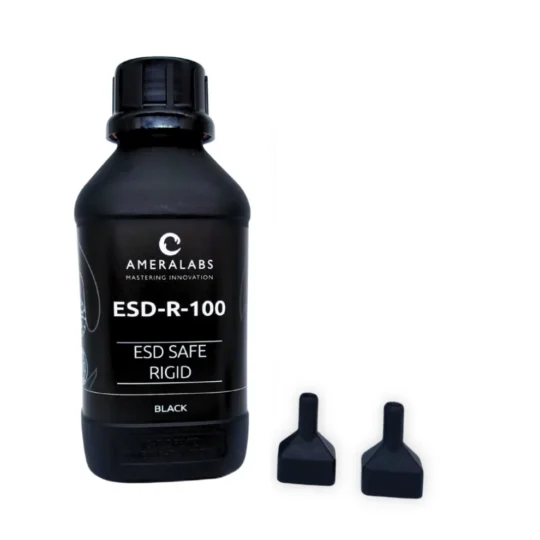
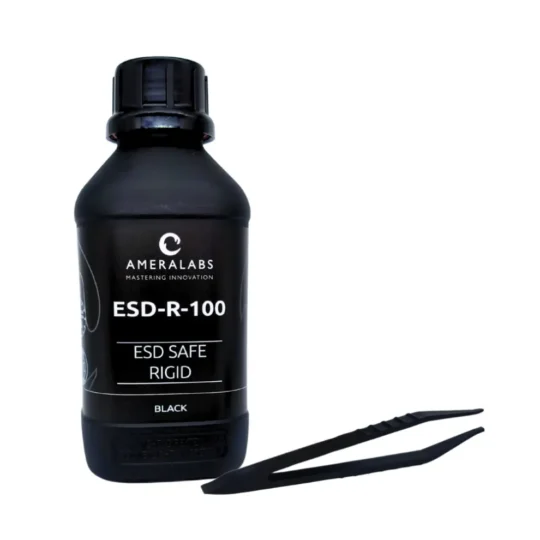
ESD-R-100
ESD safe 3D printing resin
Best suited for
- ESD-safe jigs and fixtures for electronics manufacturing
- PCB hold-down tools and component trays
- Soldering and assembly jigs
From €92.00

ESD-safe tooling you don't have to wait for
Fully static-dissipative
ESD-R-100 printed parts has surface resistivity at 10⁷ to 10¹⁰ ohm/sq, right in the ESD safe range. That protection isn't a surface coating. It runs through the entire part, so drilling, sanding, or cutting a fixture never breaks it.

Rigid, stable, and built to fit
Tensile strength hits 82.8 MPa, with a modulus of elasticity of 3.47 GPa. That rigidity keeps PCB jigs from flexing under daily handling. Water absorption stays under 1% at 24 hours (0.83%), so dimensions hold too.
Heat-tough resin
Heat deflection temperature is 96°C (ISO 75), enough to shrug off the heat from a soldering iron or a quick rework job without softening or warping mid-task. It's made for jigs that sit next to a soldering station through a full shift.
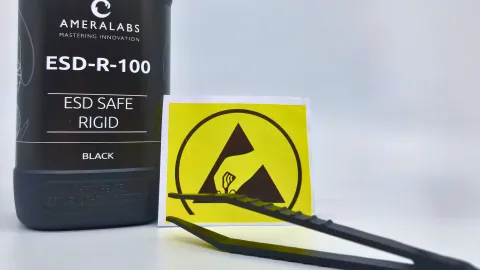
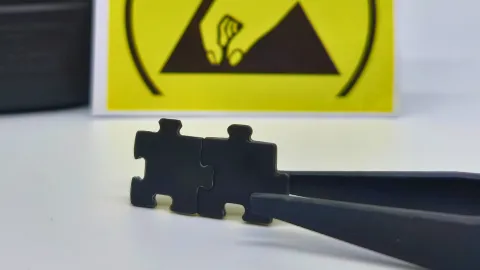

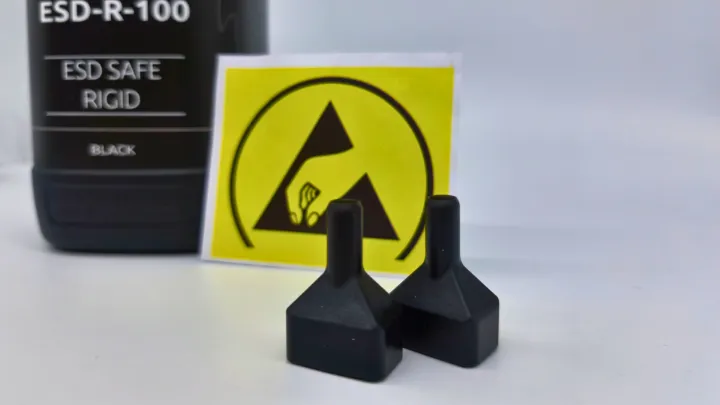
ESD-Safe Fixtures & Jigs
Static charge near sensitive electronics is a defect waiting to happen. ESD-R-100 dissipates it at 10⁷–10¹⁰ Ω/sq, all the way through the part, so any fixture or jig you print, hold-downs, trays, work-holding tools, keeps components safe from first pick-up to final placement.
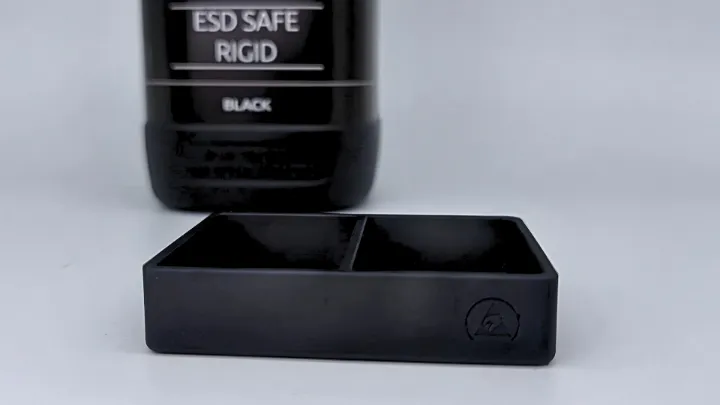
ESD-Safe Enclosures & Cleanroom Trays
No surface coating to wear off, and no static buildup to attract dust. That makes ESD-R-100 enclosures and trays a fit for dust-sensitive work, not just electronics handling.
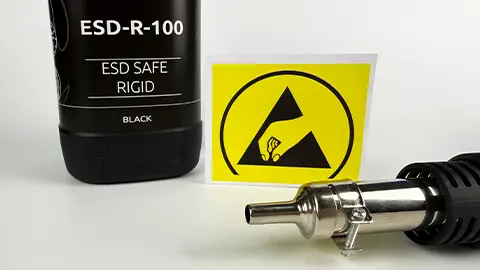
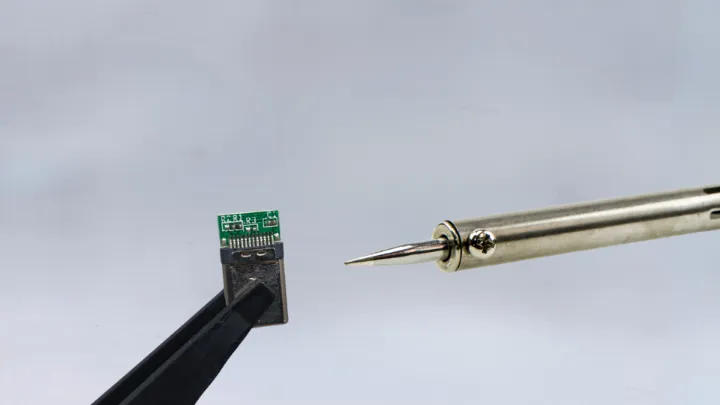
Soldering & Rework Jigs
Heat deflection temperature is 96°C, enough to sit next to a soldering iron through a full shift without softening. 88 Shore D hardness keeps the jig rigid under repeated use.
Frequently asked questions
How do I mix ESD-R-100 properly before printing?
Mix gently. An ultrasonic bath for 30 minutes works well. Avoid hard shaking, which introduces air bubbles that affect print quality and surface resistivity.
Consistent mixing matters more for carbon-pigmented resins than any other resin. A dedicated mixing station or ultrasonic cleaner for ESD materials gives uniform dispersion every time you pour.
Can I cut, sand or drill ESD-R-100 parts after printing?
Yes. Static-dissipative properties run through the entire material, so drilled, sanded, or cut surfaces remain effective.
This is the main advantage over surface-coated ESD plastics, where machining removes the conductive layer. ESD-R-100 jigs and fixtures can be modified after printing without losing protection.
How well does ESD-R-100 handle heat from soldering?
ESD-R-100 handles incidental heat and brief reflow profiles well. The heat deflection temperature is around 96 °C.
For wave-solder applications or fixtures that pass through preheat zones, test a sample first. Direct prolonged contact with a hot iron tip is not recommended.
Is ESD-R-100 suitable for cleanroom or dust-sensitive work?
Yes. ESD-R-100 does not build up static charge, so it attracts far less dust than standard plastics.
That keeps jigs and trays cleaner during use and can improve yield in particle-sensitive processes. The dissipative property holds up after normal cleaning and everyday use.
How do I clean ESD-R-100 jigs?
Use IPA and wash thoroughly. ESD-R-100 has higher viscosity than other resins, and the carbon pigmentation can leave residue, so change the wash IPA more frequently.
Dry parts completely with compressed air before post-curing. Trapped solvent can affect surface resistivity and mechanical properties over time.
Can I use ESD-R-100 for enclosures or housings?
Yes. ESD-R-100 works for ESD-safe enclosures, trays, and covers where static protection is needed without full conductivity. The dimensional stability also keeps housings and covers fitting on the first try.